
Guides
A Guide to Betting Exchanges vs Traditional Sportsbooks
Betting exchanges allow you to offer odds to other bettors instead of betting against a sportsbook. You become the house, or at least you can attempt to.
By Elena Popov3 min read
Betting exchanges allow you to offer odds to other bettors instead of betting against a sportsbook. You become the house, or at least you can attempt to.
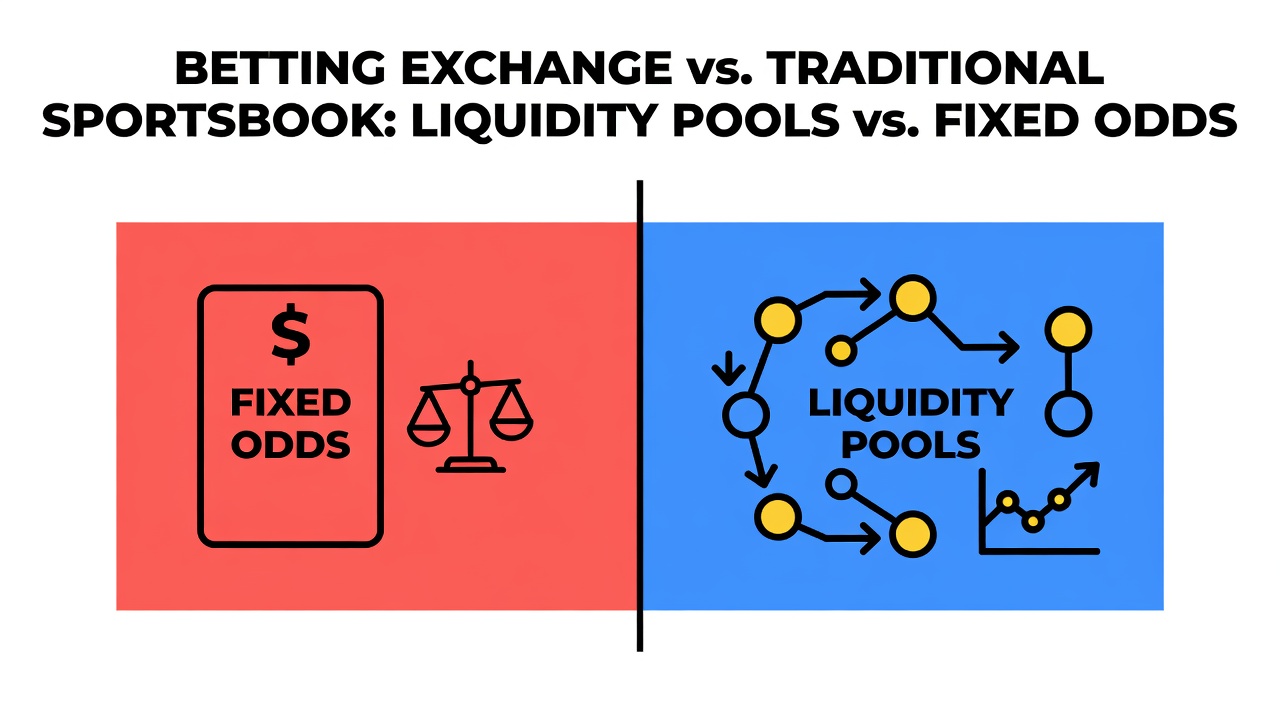
A traditional sportsbook sets odds and accepts bets on both sides. The bettor bets against the book's odds. The book collects the vig and collects payment from losers.
A betting exchange removes the book. Bettors match directly with each other. Player A wants to bet the Giants at 2:1. Player B wants to take that bet. They match. The exchange collects a small commission on the winning side, typically 2-3%.
The advantage for the bettor is that odds on exchanges are often sharper than sportsbook odds because exchanges eliminate the middleman. If a sportsbook prices the Giants at 2:1 with a 5% vig built in, a betting exchange might offer 2.1:1 between players. The sharper odds appeal to serious bettors.
The disadvantage is liquidity. A sportsbook has unlimited capacity. They will accept a 10000-dollar bet on any game. An exchange can offer only as much liquidity as other players provide. If no one wants to lay the Giants, you cannot bet on them.
Betting exchanges emerged in the early 2000s, with Betfair the dominant player. Betfair allows users to both back outcomes and lay outcomes, creating a two-sided market. The exchange takes a commission and matches players.
The regulatory landscape for exchanges is mixed. Some jurisdictions license and regulate exchanges like traditional sportsbooks. Others treat exchanges as peer-to-peer gambling, which raises different regulatory questions. Some jurisdictions forbid them outright.
The practical question for the player: Are the sharper odds worth the liquidity risk?
Key Insights and Strategic Considerations
The analysis so far covers the foundation. But there are deeper implications that most players overlook entirely. The system is designed with multiple layers of opacity that work together to obscure the true economics.
The first layer is marketing language that exploits ambiguity. The second layer is rule complexity that requires careful study. The third layer is psychological design that manipulates decision-making. These layers interact in ways that make the final outcome more favorable to the operator than a naive reading of the rules would suggest.
Consider the information asymmetry at play. The operator knows exactly how the system works and has tested it extensively. The player is learning on the fly with real money at stake. This creates a fundamental disadvantage that no amount of skill or luck can overcome for the average player.
The regulatory framework provides some protection but not complete protection. Regulators establish minimum standards, but operators are allowed to exceed those standards in negative ways. An operator can set a higher house edge than required. An operator can use more aggressive marketing than required. An operator can design games that exploit specific psychological vulnerabilities.
The practical question for any player is whether the expected value is positive enough to justify participation. For most players, the answer is unambiguously no. The expected loss is large relative to the potential entertainment value.
The lesson is not that gambling is inherently bad or that players are inherently foolish. The lesson is that games are designed by sophisticated organizations that employ mathematicians, psychologists, and engineers to maximize operator profit. Individual players without access to equivalent resources cannot beat games designed with that level of sophistication.
Understanding this creates a realistic foundation for decision-making. If you choose to participate, do so with eyes open to the mathematics and the design. Accept the expected loss as the cost of entertainment. Do not expect to overcome the system through luck or clever strategy. That way lies financial ruin.