
Craps
Gambling in Ancient Rome: Dice Games, Emperors, and Bans
In a basement storeroom at the Museo Nazionale Romano, a clay cup that once rolled bones across a tavern floor waits its turn. It is older than most of what we call history. It is also, quietly, the reason we understand how Romans played.
By Alex Chen6 min read
Silvia Ferrara kneels on the concrete floor of a storeroom beneath the Museo Nazionale Romano, her gloved hands holding a cup the color of old brick. The cup is not impressive at first. It is rough, slightly lopsided, with a cracked rim where someone in the first century dropped it on a stone floor. She rotates it under the work lamp. Inside the cup, worn smooth by two thousand years of friction, are the traces of what once made the object useful. Four tesserae. Dice.
This is a fritillus, she says. A dice cup. A man would have held this on a Tuesday evening in Ostia or Pompeii or any tavern from Britain to Syria, shaken it hard enough to hear the bones rattle, and tipped it onto a table. His friends would have leaned in. Someone would have lost a sestertius. Someone else would have called for wine.
We think of Rome as marble. Senate, Forum, Colosseum. The Romans who lived there thought of it as a place where, most nights, you could find a game in the back of a shop.
The games they played
The most common Roman dice game was tali, played with four astragali. These were not cubes. They were the knucklebones of sheep or goats, small and irregular, with four distinct faces. Each face had a different value, and the highest throw, the Venus throw, came when each of the four dice landed showing a different face. The lowest, the dog throw or canis, came when all four showed ones.
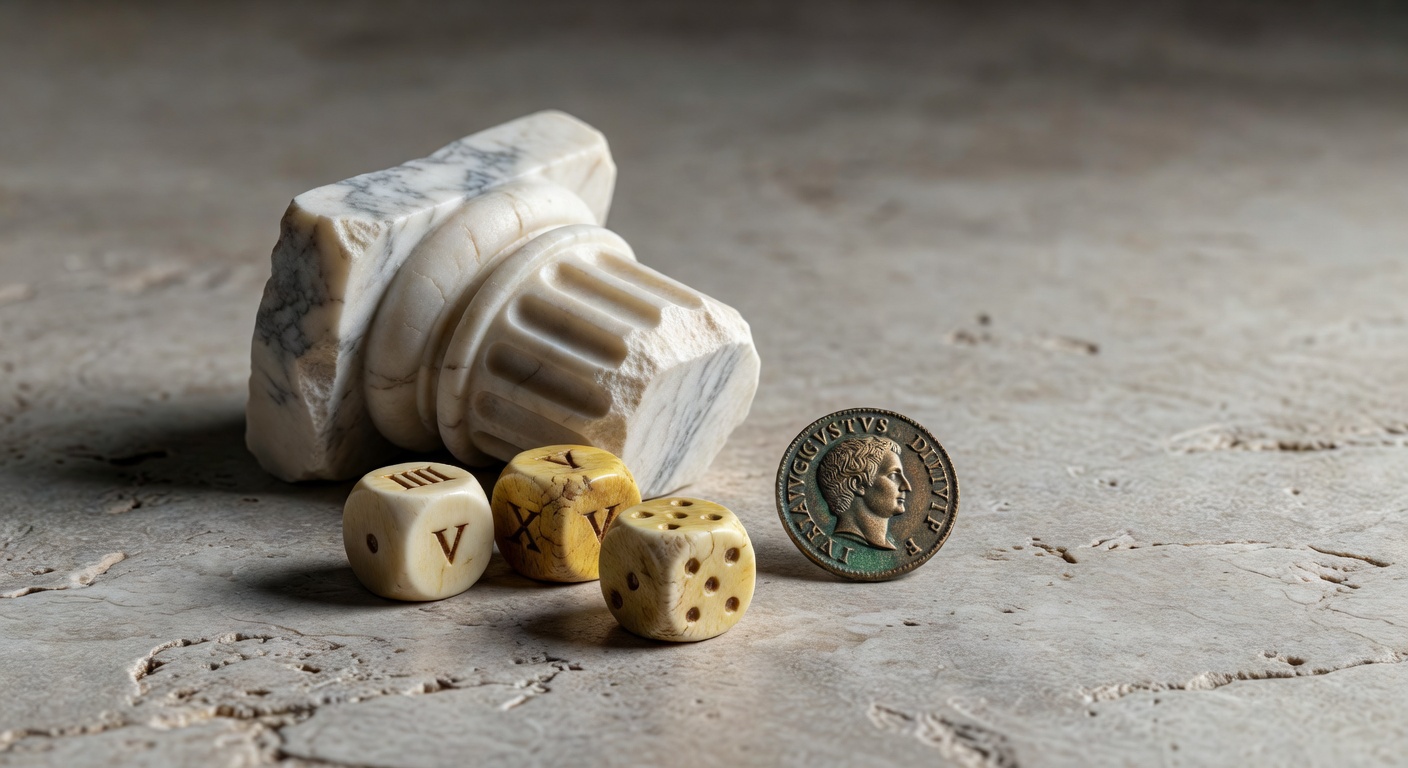
The other common game was tesserae, played with cubic dice very similar to modern ones. Three dice were standard. The Romans loved the word trium, three, the word itself had a gambling flavor. Triple sixes, trium senionum, were the top score in many games. Plutarch and Suetonius both describe emperors shouting for their throws.
There were board games played with dice mixed in. Duodecim scripta, twelve lines, was played on a wooden board with three dice and thirty counters, the ancestor of backgammon. Ludus latrunculorum, soldiers, was more chess than gambling but attracted side wagers.
And there was the ball and cup circuit, the chariot book, the gladiatorial odds. All of this existed. Not because the Romans were degenerate. Because they were people.
The emperors who played
Claudius loved dice. He wrote a book about them. The book is lost, but Suetonius, writing a generation later, reports that the emperor had his carriage fitted with a dice board so he could play while traveling. Claudius played so much that a contemporary satire, the Apocolocyntosis, attributed to Seneca, imagined the emperor in the afterlife condemned to roll dice from a bottomless cup forever. The Roman joke worked because everyone in the audience had a relative who played like that.
Nero played. Augustus played, and in letters to his daughter he mentions the exact amounts he won and lost at a party the night before. Commodus lost public money at the tables and was mocked for it. Caligula was said to have cheated by loading his dice, which is the earliest recorded accusation of crooked dice in Roman literature, though possibly not the earliest instance.
The emperors played even though the law, technically, forbade it.
The bans
This is the part that always makes modern readers do a small double take.
Gambling was illegal in Rome for most of the Republic and much of the Empire. The relevant statutes were the lex alearia and later the lex Titia and the lex Publicia, enacted in the second century BCE and amended repeatedly. The laws banned games of chance for money, with a narrow exception: betting on contests of physical skill, including gladiatorial fights and athletic competitions, was permitted. Dice did not qualify as a contest of skill.
The penalty, in the earlier laws, was a fine of four times the stakes. Later laws allowed civil suits in which gambling losers could sue to recover their losses, which created a strange incentive structure in which the winner had to trust the loser not to turn around and take him to court the next morning.
Cicero, in one of his orations, refers to professional gamblers as infames, persons of disrepute, legally disqualified from certain civic roles. The law took the matter seriously. The law also, visibly, did almost nothing.
The Saturnalia exception
There was one time of year when it was legal. During the Saturnalia, the December festival honoring Saturn, the statutes lifted. For seven days, or sometimes fewer depending on the period, gambling was permitted in public. Tavern doors opened, dice cups appeared on every table, and the city ran a citywide approved bender.
The concession was deliberate. Roman social order rested on a set of reversals during Saturnalia. Masters served their slaves at meals. Normal clothing was set aside for colored tunics. And the gambling laws, which existed to preserve public order and the dignity of the paterfamilias, were suspended because everyone agreed that a few days of collective rule-breaking was safer than a year of it bottled up.
The rest of the year, the law persisted, and the games continued. Romans played in taverns, in private homes, in the back rooms of bathhouses, and, on a few well-documented occasions, on the steps of the Senate itself. Enforcement depended on who was playing and who was watching. A senator caught rolling dice at the Curia risked public humiliation. A wine merchant in Ostia caught rolling dice in his own shop risked, realistically, nothing.
The material record
Silvia Ferrara has rotated the fritillus three more times. She sets it down. From a padded tray she produces a small leather bag and opens it carefully. Inside, five loaded dice from the ruins of Pompeii. Each has been shaved or weighted on one side. She lines them up under the lamp. They are not pretty. They are the earliest archaeological evidence of cheating dice in the Western world. They were recovered in 1874, from the villa of a private citizen whose name is not recorded but whose life, clearly, contained more drama than we will ever map.
The Romans who played these games were not moral abstractions. They were tired after a day of hauling grain, or drunk on a feast day, or bored on a Tuesday in March, the way Sonia is bored in her apartment, the way we all are, and they reached for a cup and four knucklebones because dice have always been a way of borrowing, briefly, against the future.
Silvia returns the objects to their padded trays. She closes the drawer. The storeroom fluorescent lights hum faintly. Somewhere above us, the museum is closing for the evening, and the tourists are heading back to their hotels, and an Italian teenager is playing poker on his phone on the Metro B line, unaware that the small rattling object of a two-thousand-year-old tavern is still, in every meaningful sense, inside his hand.