
Guides
How to Study Poker Hands Away From the Tables
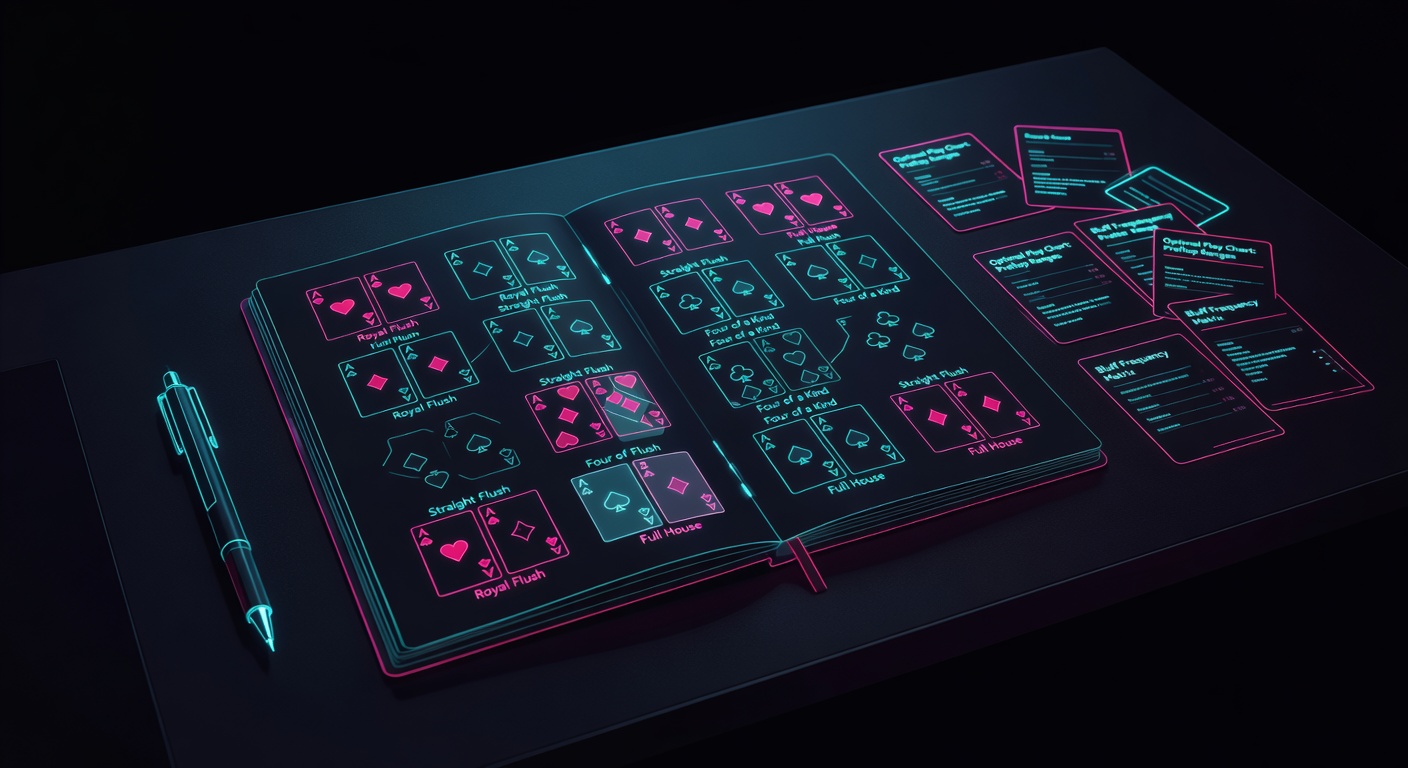
The first tool is a pen and paper. Write down the hand. Write down your decision. Write down what happened. Repeat five thousand times. At that point, you've learned something.
By Elena Popov4 min read
The interesting part is figuring out why you made the decision you made. A hand at 3 a.m. after playing for eight hours feels different from a hand at noon after sleeping fourteen hours. The hand is identical. Your thinking is not.
Studying poker away from the table means separating the hand from the context. You extract the hand from memory or video. You remove the emotional weight. You ask: what was the correct play?
The Basic Setup
You need three things: hands, tools to analyze them, and a framework for learning.
Hands come from your own play (review your session), streams (watch professionals play), or simulators (Practice software that generates hands and lets you solve them).
Tools include solvers (GTO-focused analysis), equity calculators (probability-focused), and databases (pattern recognition).
Framework means having a method. Some players review only losing hands. Some review every hand from every session. Some review hands from specific types (early position, small blind situations). The method doesn't matter; consistency does.
Learning From Your Own Hands
The most direct learning comes from your own mistakes. A mistake is a hand you played where you later understood you made an error.
Write down: position, stack sizes, bet sizes, your decision, the result, and what you should have done.
Position matters because a hand from the button plays differently than a hand from under the gun. Stack sizes matter because a hand with 100 big blinds plays differently than a hand with 10. Bet sizes matter because a hand where someone bet 25 percent of the pot plays differently than a hand where someone bet 200 percent.
After fifty of these documented hands, patterns emerge. You'll notice you fold too much from the small blind. You'll notice you call too wide against raises. You'll notice you never value-bet thin. These are learnable patterns.
The Professional Method
Higher-level players use solvers. A solver is software that calculates the optimal play for any given hand situation using game theory (specifically, Nash equilibrium concepts).
Monker is expensive but excellent. PokerSnowie is accessible. These programs let you input a hand situation (your cards, community cards, opponent's betting) and the solver tells you the mathematically optimal play.
Solvers don't solve poker completely (too many variables), but they solve specific situations. If you're studying early position opens, the solver tells you which hands open and which fold. If you're studying responses to flop bets, the solver tells you the range and frequencies.
Using a solver requires patience. You input a situation, the solver runs for minutes or hours (depending on complexity), and you get an answer. You then study why the answer makes sense.
The Database Method
Some players build databases. Every hand they play is logged with results. After years, they have thousands of hands organized by situation.
They look for patterns. How often do they win from the button? How often do they win after 3-betting? How often do opponents fold when they bet?
Data reveals patterns that memory obscures. You think you win 60 percent of the time from the button. The database shows 54 percent. That 6 percent discrepancy is either luck or a mistake in your play.
The Vulnerability
Studying away from the table has a risk: you optimize for average hands, not for exploit hands.
A solver tells you the mathematical optimal play against a theoretically perfect opponent. But in reality, opponents make mistakes. A bettor who always bets too large on the flop is not playing optimally. Against that specific opponent, a counter-strategy exists that beats optimal play.
Studying at the table (playing live) teaches you to spot these exploits. Studying away from the table teaches you the foundation so you don't make basic mistakes while looking for exploits.
The Order of Learning
First: study the framework. Learn position, stack sizes, hand rankings, basic strategies.
Second: study your own hands. Identify where you make mistakes.
Third: study professional hands. Watch how players handle the situations you mishandle.
Fourth: use a solver to optimize your play in critical situations.
Fifth: return to the table with better fundamentals and notice exploits.
Most players skip steps one through four and go straight to exploiting. This is why most players lose.