
Poker
Tipping Dealers in Live Poker: What's Appropriate
I dealt blackjack on the Las Vegas Strip for fourteen years. The most important thing I learned was not about cards or shuffling techniques.
By Alex Chen3 min read
I dealt blackjack on the Las Vegas Strip for fourteen years. The most important thing I learned was not about cards or shuffling techniques. It was about money and its profound effect on human behavior.
A casino dealer in Nevada makes minimum wage, roughly six dollars an hour in 1998 money. Everything else is tips. The house takes a percentage of the rake. The state takes taxes. What remains is what the dealer actually makes.
The economy of the table is three-part. The house takes its cut. The player loses to variance. The dealer lives in the margin.
I came up in the late eighties when tipping was not yet fully systematized. A dealer at a craps table might make fifty dollars a shift. A dealer at a high-limit blackjack table might make three hundred. The variance in dealer income was enormous.
Vegas tipping was still informal. A whale might throw a thousand-dollar chip at a dealer after a lucky streak. A grinding player might tip a dollar per win. There was no standard. The game was negotiated individually at the table.
By the time I left in 2012, tipping had become structured. A player tipping one dollar per fifty-dollar win was standard. A player tipping one chip on a blackjack win was baseline. Anything less looked cheap or disrespectful.
The Unspoken Rule
The rule that nobody states but everybody knows: if you are winning big, you tip the dealer. Not because it is kind. Because the dealer is part of the infrastructure making the win possible.
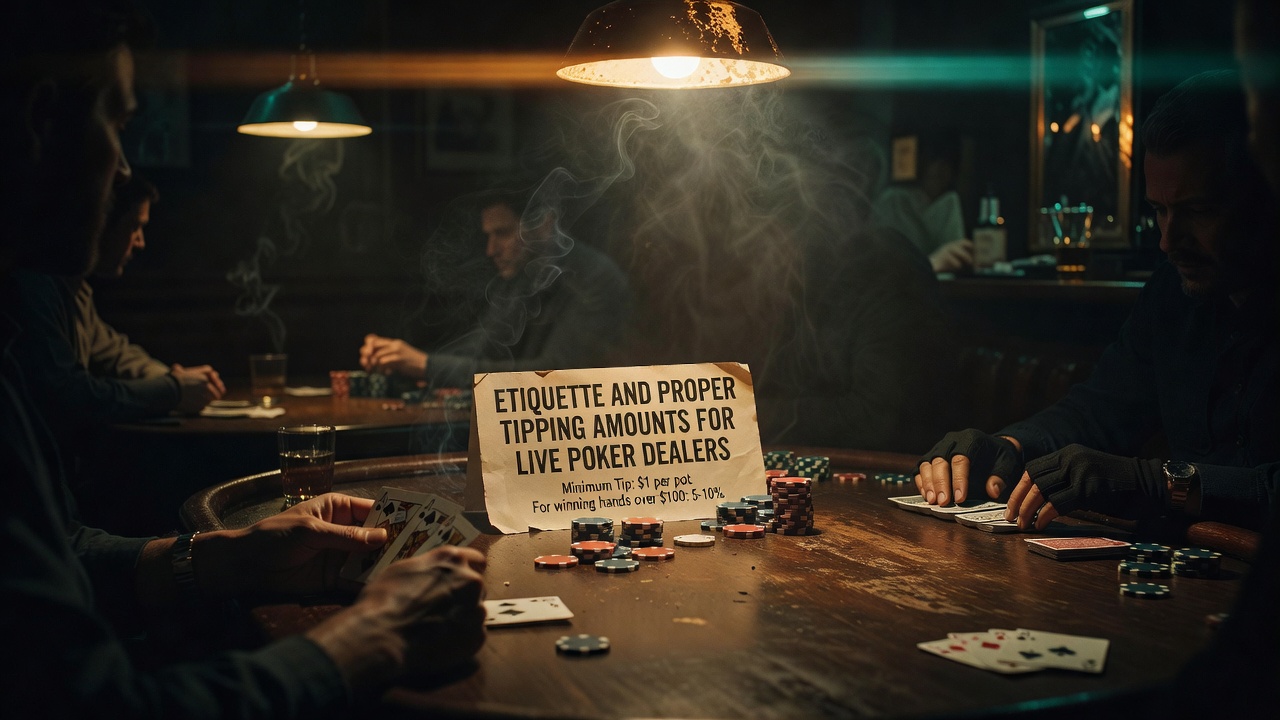
A dealer at a poker table is not actively helping you win. But they are maintaining the game structure. If you are winning ten thousand from a cash game, a two-percent tip to the dealer is baseline courtesy.
If you are losing, you tip when you leave. Not because the dealer failed you, but because the dealer spent the time with you. Fifty dollar loss, five dollar chip. The signal is: I played well, ran bad, but I am not blaming you.
Card counting changed everything in the seventies. Casinos responded with surveillance and rules changes. Dealers caught in the middle. They were not counting. They were just dealing the cards the way management demanded.
But a dealer who is friendly, or slightly slower, or slightly faster, can affect the game's efficiency. Dealers understood this. The best dealers could adjust speed and depth minutely without the pit boss noticing.
This is why dealers were so important to long-term play. A friendly dealer was worth edge reduction. An unfriendly dealer was worth edge increase. Tipping is not generosity. It is recognition of the structure.
Additional Considerations
Beyond the basics, several other factors come into play. Understanding these nuances helps inform better decisions going forward.
The intersection of player psychology and game structure creates dynamics that transcend simple mathematical analysis. Real players make real decisions under real constraints.
Practical Takeaways
For players looking to optimize their approach, remember these core principles. First, knowledge of the underlying structure matters. Second, emotional discipline separates winners from losers. Third, bankroll management is the foundation of any sustainable approach.
The difference between casual play and serious play is often this: serious players understand the mechanics. They play within clear constraints. They do not let variance destroy their decision-making.
Final Thoughts
Understanding this topic provides a foundation for better decision-making. Whether you are building a bankroll, protecting against downswings, or simply trying to maximize your entertainment value, these principles apply.
The games themselves have not changed. The player's advantage remains the same: understanding what others do not, and acting accordingly.