
Blackjack
Why Single Deck Blackjack Isn't Always the Better Choice
The casino floor at the Cosmopolitan in Las Vegas has a pit of single-deck blackjack tables. The cards come from a shoe no bigger than a standard deck of playing cards. No mechanical shuffle machine.
By Elena Popov3 min read
The casino floor at the Cosmopolitan in Las Vegas has a pit of single-deck blackjack tables. The cards come from a shoe no bigger than a standard deck of playing cards. No mechanical shuffle machine. A dealer, two players maximum per table. This is where the misconception lives and costs money.
Danny came in at nine PM on a Thursday in October. He had read the guides. Single deck is better for the player. Double deck slightly worse. Six decks worse still. This is true on paper. On the floor, under lights, with a real dealer, the relationship inverts.
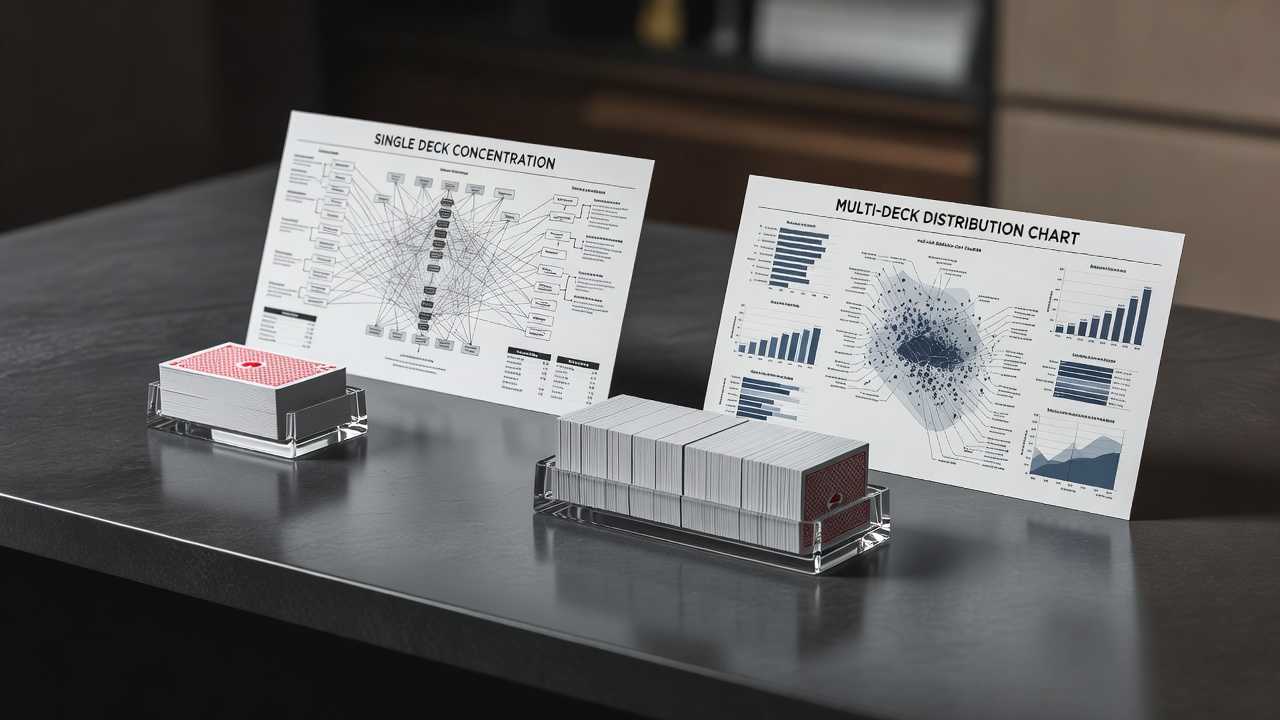
The math that fools people is straightforward. Single deck has a house edge of around 0.16 percent with perfect play. Six-deck games run 0.48 percent. The difference looks real. On a thousand hands, it is three hundred dollars.
But the casino where single deck exists can set the rules differently. Single deck at the Cosmopolitan pays six to five for blackjack, not three to two. A natural twenty-one on a ten-dollar bet pays twelve dollars instead of fifteen. This difference alone swallows the entire mathematical advantage of fewer decks.
The Hidden Architecture
This is casino design, not cheating. It is legal. The pay scale is posted on the felt. Danny could have read it. He did not understand the implication. Or he understood it and thought his strategy could overcome it anyway.
The payout alteration changes the fundamental game structure. In traditional blackjack, the player's advantage increases with deck penetration (more cards removed equals fewer tens and aces left). In single-deck six-to-five payout, the payout reduction is permanent. Deck penetration helps, but not enough.
Danny started with two hundred dollars. He played the hands correctly. His basic strategy was tight. He split when he should, stood when he should, doubled on correct count. After an hour, he was down to one-forty.
He doubled down. Played another two hours. By the time the shift change happened, he had gone through the original two hundred, reloaded with another three hundred, and left with sixty dollars.
The Lesson in Numbers
His per-hand cost was roughly two dollars on a nine-dollar average bet. This is consistent with the six-to-five payout single-deck game.
If he had played the same hands at a six-deck table with three-to-two payouts, his expected loss would have been one-fifty. The difference: one hundred dollars in a single night. The strategy: identical. The structure: the determinant.
There is one pure single-deck game remaining in major casinos: at high-minimum tables with three-to-two payouts. The minimum is often one hundred dollars. For the player with two hundred dollars, the single-deck games that exist are mathematical traps.
Additional Considerations
Beyond the basics, several other factors come into play. Understanding these nuances helps inform better decisions going forward.
The intersection of player psychology and game structure creates dynamics that transcend simple mathematical analysis. Real players make real decisions under real constraints.
Practical Takeaways
For players looking to optimize their approach, remember these core principles. First, knowledge of the underlying structure matters. Second, emotional discipline separates winners from losers. Third, bankroll management is the foundation of any sustainable approach.
The difference between casual play and serious play is often this: serious players understand the mechanics. They play within clear constraints. They do not let variance destroy their decision-making.
Final Thoughts
Understanding this topic provides a foundation for better decision-making. Whether you are building a bankroll, protecting against downswings, or simply trying to maximize your entertainment value, these principles apply.
The games themselves have not changed. The player's advantage remains the same: understanding what others do not, and acting accordingly.